Medically reviewed by Dr. Anna M. Melamed, MD, Boston Medical Spa · Last updated: June 2026
AI treatment planning uses facial-analysis software to map your face, simulate likely outcomes, and build a personalized, often multi-area plan before any needle is involved. It makes the consultation more objective by replacing guesswork with imaging data, and it lets you preview realistic results in advance. Used correctly, with a licensed provider interpreting the output, it improves planning, expectation-setting, and the odds of a natural result.
The major manufacturers are now building this into the consultation itself. In January 2025, Allergan Aesthetics launched its AA Signature program at the IMCAS World Congress, a structured approach to planning treatments across multiple facial areas rather than one zone at a time. Here is what AI-assisted planning actually does, what the data says, and the questions a careful patient should ask.
What is AI treatment planning in aesthetics?
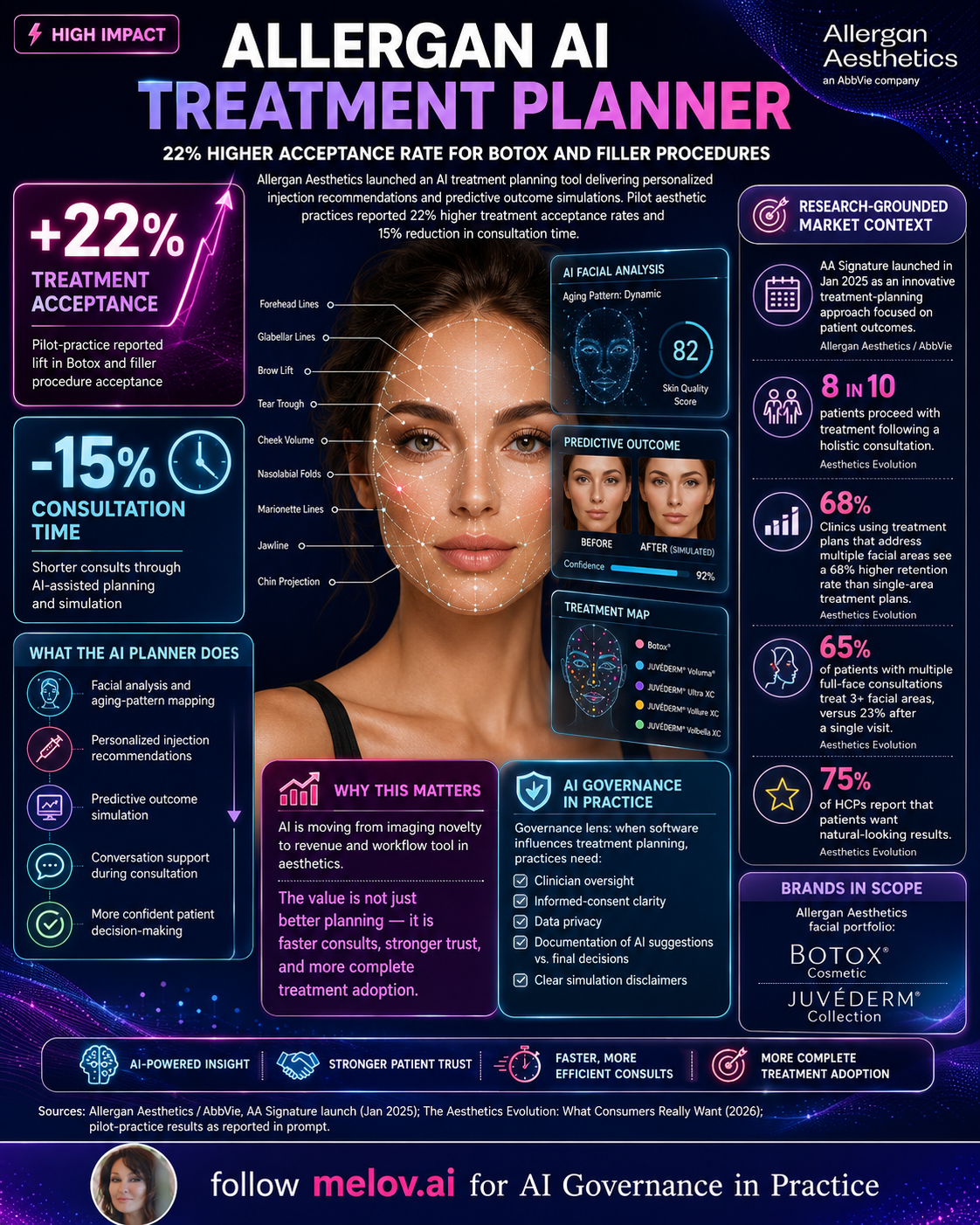
AI treatment planning is a consultation method where software analyzes a photo or 3D scan of your face, identifies aging patterns and structural features, and helps the provider build a tailored plan. The technology does three things: facial analysis and aging-pattern mapping, personalized treatment suggestions, and predictive outcome simulation that shows a likely before-and-after.
The point is to move the conversation from subjective opinion to shared data. Instead of a provider pointing at a mirror, you both look at the same analysis and the same simulated outcome. That shared reference is what makes the plan easier to understand and agree on. The software supports the decision, but a licensed medical provider still makes the clinical call.
Why are clinics shifting from single-area to holistic plans?
Clinics are moving toward holistic, multi-area plans because both patient demand and outcomes data point that way. According to Allergan Aesthetics' AA Signature research, 9 in 10 people are interested in a holistic plan that targets multiple areas of the face, more than 1 in 3 specifically want improvement to the chin, jawline, or side profile, and 94% want better facial skin quality.
The retention data is striking. Allergan reports that clinics using treatment plans addressing multiple facial areas see a 68% higher patient retention rate than those treating one area per visit, based on a study of more than 2,600 patients across seven practices on five continents. A full-face plan tends to produce a more balanced result, which is one reason AI planning tools are built around mapping the whole face rather than a single line.
Can AI show me my results before I commit?
Yes. Predictive outcome simulation is one of the core features of AI planning tools, generating a side-by-side preview of your current appearance and a likely result so you can judge whether it matches what you want. Several platforms simulate specific treatments across different facial zones, from cheek and lip volume to jawline definition.
This directly addresses two of the most common reasons people hesitate. Fear of an unnatural or overdone result, and fear of the unknown, are among the top barriers patients report before booking. Seeing an achievable, realistic preview on your own face, rather than a stock before-and-after, helps set honest expectations. The simulation is a communication tool, not a guarantee, and any responsible clinic will label it clearly as a projection rather than a promised outcome.
Does AI planning actually lead to more natural results?
AI planning supports natural results because it is built around the same goal patients now overwhelmingly ask for: subtlety. Allergan Aesthetics' Layered Beauty global survey of 12,000 consumers found that 85% prefer natural and subtle outcomes, 74% want results that are undetectable, and 71% actively fear looking fake or overdone.
A planning tool that maps the whole face and simulates a measured outcome makes it easier for a provider to plan conservatively and for a patient to spot if a proposed change looks like too much. The technology does not create a natural result on its own. An experienced injector does that. What the tool adds is a shared, visual way to keep the plan in the subtle range that most patients actually want. If you are weighing options, our guide on why Botox fades faster and the regenerative alternatives covers the trade-offs in more depth.
"The value of AI in a consultation is not that it makes the decision. It is that the patient and I look at the same map and the same simulation, so expectations are set honestly before anything is done. The clinical judgment still belongs to the provider."
Dr. Anna M. Melamed, MD, Boston Medical Spa
What are the limits, and what should you ask?
AI treatment planning is a decision-support tool, not a diagnosis, and it should always sit under licensed clinician oversight. Before you trust an AI-assisted consultation, there are fair questions to ask, because software that influences a medical plan carries real responsibilities.
A well-run clinic should be able to answer five things clearly: who provides clinical oversight of the AI's suggestions, how informed consent is handled when software shapes the plan, how your facial images and data are stored and protected, whether the clinic documents how it weighed AI suggestions against the provider's final decision, and whether every simulation is presented with a clear disclaimer that it is a projection, not a guaranteed outcome. For a broader vetting framework, see how to find a reputable med spa.
Quick answers
What is AI treatment planning? Software that analyzes your face, suggests a personalized multi-area plan, and simulates a likely outcome, used by a licensed provider to guide the consultation.
Does it make results more natural? It supports natural results by helping plan the whole face conservatively, but the provider's skill, not the software, produces the outcome. Allergan's survey found 85% of consumers want natural, subtle results.
Can I see my result first? Yes, predictive simulation shows a likely before-and-after on your own image, clearly labeled as a projection rather than a guarantee.
Is my data safe? Ask the clinic directly how facial images are stored and protected, and confirm a clinician oversees every AI suggestion.
Related reading
- How to Find a Top Med Spa Near You: Same-Day Booking and Real Authority
- Botox vs. Fillers: What's the Difference?
- Why Botox Fades Faster, and the Regenerative Alternatives
- Med Spa Industry Report 2026
This article is educational and not medical advice. AI tools support, but do not replace, a licensed medical provider's assessment. Treatment suitability depends on an in-person consultation.