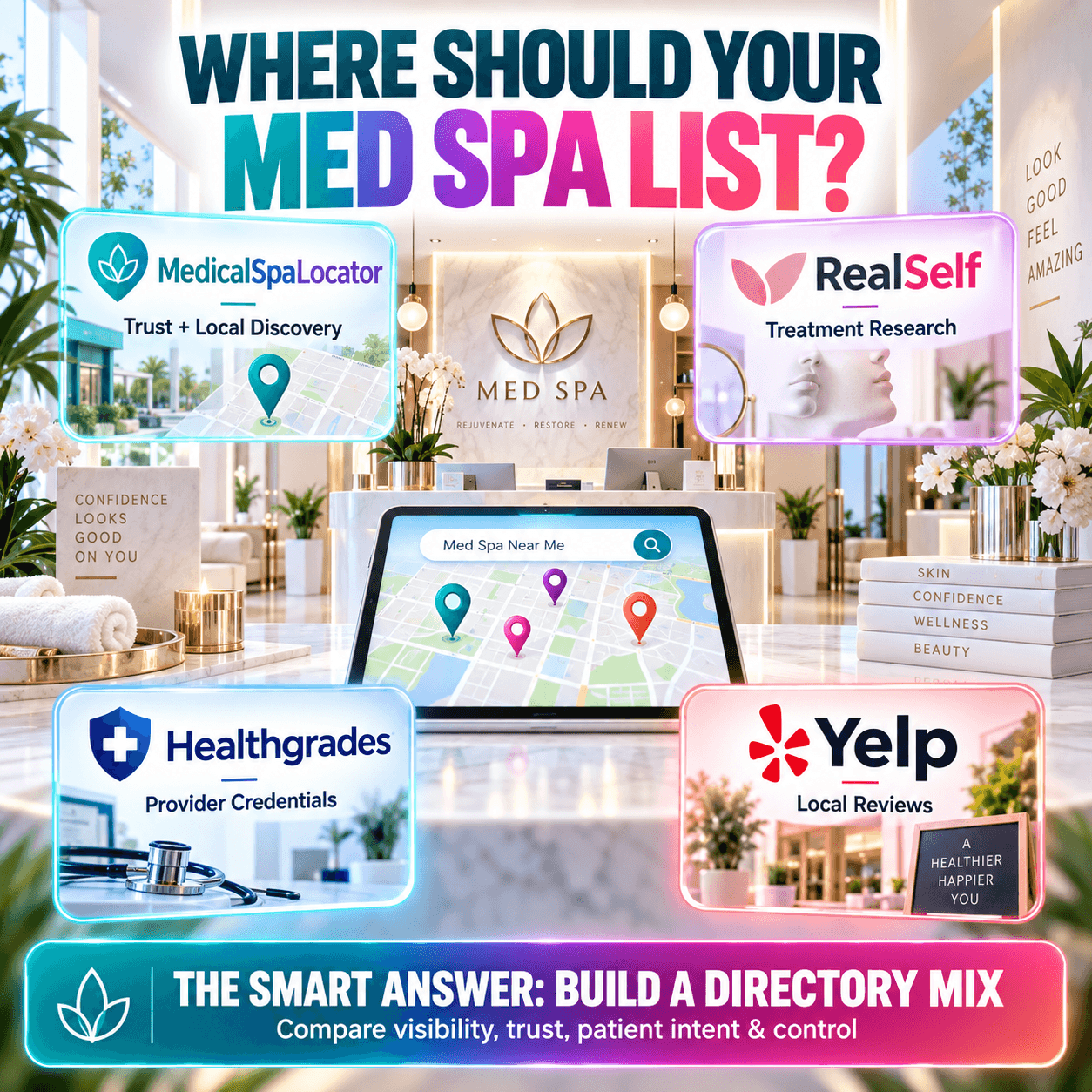
Deciding where a med spa should list online usually comes down to one real question: which platform will an actual patient — or an AI assistant answering on their behalf — surface first, and what does it cost to make sure that happens. Here's how MedicalSpaLocator, RealSelf, Healthgrades, and Yelp actually compare, not just on paper.
The short answer
RealSelf and Healthgrades are the two largest cosmetic-treatment directories in the U.S., built for national brand reach and priced for practices that can absorb an enterprise sales process. Yelp is a general local-business directory where med spas compete against every other business category for attention. MedicalSpaLocator is a directory built specifically for medical spas, with published pricing and a directory-wide focus on the structured data — pricing, treatment specificity, credential documentation — that AI answer engines like ChatGPT and Perplexity actually cite.
None of these is a strict replacement for the others. Most med spas that take online visibility seriously end up listed on more than one.
Who each platform is actually built for
RealSelf is the largest cosmetic-procedure community in the country — patient reviews, before-and-after photos, and a Q&A forum where board-certified doctors answer questions publicly. It's strongest for surgical and higher-ticket cosmetic procedures and skews toward plastic surgeons and dermatologists rather than independent med spas. A basic profile is free to claim; RealSelf does not publish what it charges providers for its paid "Spotlight" placements — pricing is handled through a sales conversation.
Healthgrades is a general healthcare directory that happens to include med spas as one category among physicians, dentists, and hospitals. Claiming and correcting a basic profile is free. Enhanced visibility and reputation-management features are paid add-ons, and — same as RealSelf — the price isn't published; it's quoted per practice.
Yelp is not a medical directory at all. It's a general local-business platform where a med spa's listing sits next to restaurants and auto shops. Its strength is review volume and local search habit — a lot of people still default to Yelp out of muscle memory — but it offers zero med-spa-specific structure: no treatment-level pricing fields, no credential documentation, no way to distinguish a licensed medical director from a day-spa esthetician. Advertising is pay-per-click through Yelp Ads, with cost driven by bid competition in your metro, not a fixed rate.
MedicalSpaLocator is narrower on purpose. Every listing is a med spa — not a mixed bag of specialties — across 18,173+ listed med spas in more than 1,000 U.S. cities. Pricing is published on the site, not gated behind a sales call. The structure is built around the specific fields AI engines pull from when someone asks ChatGPT or Perplexity where to get Botox in a given city: treatment-level pricing, medical director credentials, and a Trust Index that separates a merely claimed listing from one that has actually gone through review.
Side-by-side
| MedicalSpaLocator | RealSelf | Healthgrades | Yelp | |
|---|---|---|---|---|
| Med-spa-specific | Yes — every listing is a med spa | Partial — mixed with plastic surgeons/dermatologists | No — general healthcare directory | No — general local business directory |
| Free basic listing | Yes | Yes (claimed profile) | Yes (claimed profile) | Yes |
| Published pricing for paid tiers | Yes — listed on site | No — sales-quoted | No — sales-quoted | Pay-per-click, bid-based |
| Verification model | Trust Index review (separate from a free claimed listing) | Doctor credentials shown; profile claim itself isn't independently vetted | AMA / state board / hospital-affiliation checks on physician data | None specific to medical credentials |
| AI-citation-oriented structure | Built for it | Not the design focus | Not the design focus | Not present |
| Best fit | Independent and small multi-location med spas that want a specific, AI-searchable presence without an enterprise sales cycle | Surgical/high-ticket cosmetic practices, especially plastic surgeons | Practices already investing in general healthcare reputation management | Practices that want local review volume as one channel among several |
What this actually costs
MedicalSpaLocator publishes its pricing: a free claimed listing, then paid tiers at $97, $197, and $297 per month, plus a custom tier for multi-location groups. What you get at each tier is on the pricing page, not behind a call.
RealSelf and Healthgrades don't publish what they charge for enhanced placement. Both require a sales conversation to get a number, and neither discloses pricing in press or on their own sites. Yelp Ads runs on a cost-per-click auction, so the effective monthly cost depends entirely on how competitive your metro and treatment category are that month — there's no flat rate to compare against.
If a med spa owner's first question is "what will this cost me before I talk to a salesperson," MedicalSpaLocator is the only one of the four with an answer already on the page.
Where this is heading
Patients are increasingly asking ChatGPT, Perplexity, and Google AI Overviews where to get a treatment done — not just Googling and clicking through ten blue links. Which directories those AI engines cite depends heavily on whether a listing carries the kind of structured, specific information (real pricing, named credentials, treatment detail) that a general-purpose directory like Yelp was never built to hold and that RealSelf and Healthgrades, built for a different scale and audience, haven't prioritized either. That's the gap MedicalSpaLocator is built to fill — not by being bigger, but by being the one directory where every listing is structured for the questions patients are now asking an AI instead of a search bar.