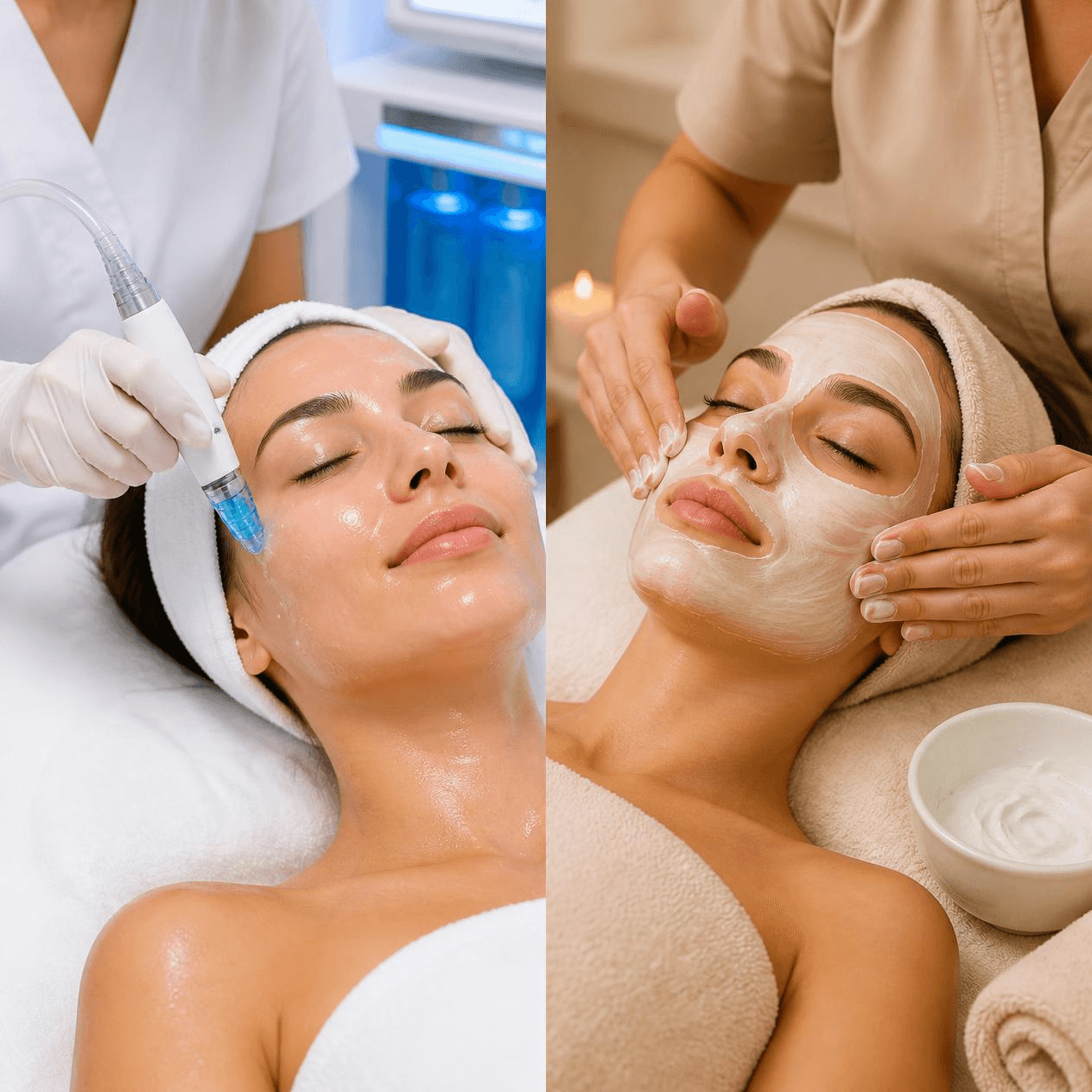
Quick Answer
A HydraFacial is a patented, device-based treatment that cleanses, exfoliates, extracts, and infuses serums in one 30-minute session — consistent results, no downtime, $150–$350. A traditional facial is a customizable, hands-on treatment that typically includes steaming, manual extractions, a mask, and massage — more relaxing, typically 60–90 minutes, $75–$200. HydraFacial is better for consistent results, sensitive or acne-prone skin, and "look good tomorrow" events. Traditional facials are better for relaxation, deeper product customization, and ongoing skin education from an esthetician who gets to know your skin.
Side-by-Side Comparison
| Feature | HydraFacial | Traditional Facial |
|---|---|---|
| How it works | Patented vortex-fusion device delivers serums and suctions debris | Manual cleanse, steam, extractions, mask, massage |
| Duration | 30–45 minutes | 60–90 minutes |
| Typical cost | $150–$350 | $75–$200 |
| Downtime | None | None, though extractions may leave temporary redness |
| Customization | Via serum "boosters" (Britenol, Dermabuilder, CTGF) | Fully customizable — products, techniques, pressure |
| Extractions | Automated via suction vacuum | Manual by the esthetician |
| Good for sensitive skin | Yes — no manual manipulation | Depends on esthetician technique |
| Good for active acne | Yes — won't spread bacteria manually | Only with a skilled esthetician |
| Consistency across providers | High — device-driven protocol | Variable — depends on esthetician |
| Relaxation factor | Moderate — device is audible | High — massage, warm towels, quiet |
| Results visible | Immediately — skin looks brighter same day | Next day after extractions settle |
| Recommended frequency | Monthly | Every 4–6 weeks |
What Actually Happens in a HydraFacial
HydraFacial is a trademarked device (originally developed by Edge Systems, now owned by Beauty Health) that performs three steps using patented HydroPeel tips:
- Cleanse + peel — a gentle glycolic/salicylic acid solution loosens dead skin and debris.
- Extract + hydrate — vortex suction pulls debris out of pores while simultaneously delivering hydrating serum. This is the "vortex-fusion" step that distinguishes HydraFacial from competing devices.
- Fuse + protect — antioxidants, peptides, and hyaluronic acid are pressed into the skin.
Optional boosters (for an extra $30–$80) target specific concerns: Britenol for dark spots, Dermabuilder for fine lines, CTGF (connective tissue growth factor) for firmness. An LED light tower or lymphatic drainage step may be added at higher-tier tiers (e.g., "Platinum HydraFacial").
What Actually Happens in a Traditional Facial
A traditional facial is customized by the esthetician based on your skin assessment. A typical 60-minute session:
- Consultation + skin analysis — esthetician examines skin under magnification
- Double cleanse — oil-based then water-based
- Steam — 8–10 minutes to open pores
- Manual exfoliation — scrub, enzyme, or light acid peel
- Manual extractions — 5–15 minutes depending on skin
- Massage — face, neck, décolleté, sometimes arms and hands
- Mask — targeted to your skin's current state
- Serum + moisturizer + SPF
The quality of a traditional facial is almost entirely about the esthetician — a gifted esthetician can customize product selection, extraction technique, and massage pressure in ways no device can replicate. A mediocre esthetician with the same license may deliver a generic service that underperforms a HydraFacial.
When HydraFacial Is Worth the Upgrade
- You have an event tomorrow. HydraFacial results show immediately with no redness from manual extractions.
- You have sensitive skin, rosacea, or easily irritated skin. The device is gentler than manual manipulation.
- You have mild-to-moderate active acne. Vortex suction removes debris without spreading bacteria across skin the way manual extractions can.
- You want consistent, predictable results every month. Because it's device-driven, results are reproducible across visits.
- You're new to a med spa and don't know the estheticians yet. HydraFacial reduces variance while you find a regular provider.
- You're 40+ and want anti-aging boosters. Peptide and growth factor boosters penetrate better via vortex-fusion than topical application alone.
When a Traditional Facial Is the Smarter Choice
- You want to relax. Traditional facials include massage, warm towels, and quiet — HydraFacial is a working treatment, not a spa day.
- You have complex skin needs and want a long-term esthetician relationship. A regular esthetician who knows your skin can adjust products and techniques over time.
- You need deep manual extractions. Cystic or deeply embedded blackheads often require manual work that vortex suction can't reach.
- You're on a budget. A $90 traditional facial monthly ($1,080/year) can maintain good skin for half the cost of monthly HydraFacials.
- You want custom product selection. Estheticians can use professional-grade acids, enzymes, and masks not available on HydraFacial device menus.
Cost Breakdown
HydraFacial by tier:
- Signature (30 min, basic 3-step): $150–$200
- Deluxe (45 min, 1 booster + LED): $200–$275
- Platinum (60 min, lymphatic + booster + LED): $275–$350
Traditional facials by type:
- Express (30 min): $50–$85
- Classic (60 min): $75–$150
- Deluxe (75–90 min, includes add-ons): $125–$200
Most med spas offer 10–15% off when you buy packages of 4–6 treatments at once.
What About "Hydrafacial-Style" Dupes?
Several devices mimic the vortex-fusion concept at lower cost: Aquafacial, Hydro-dermabrasion, and various generic hydration-infusion devices. They share the basic principle (cleanse + suction + serum) but lack HydraFacial's patented HydroPeel tips, serum formulations, and training protocols. If you see a med spa advertising "HydraFacial-like treatment for $79," it is almost certainly a dupe — that's fine, but know what you're buying. Only HydraFacial-branded treatments use genuine HydraFacial serums and protocols.
How to Get the Most From Either Treatment
- Go monthly. Either treatment works best with consistency — skin turnover is roughly 28 days.
- Avoid retinoids for 3–5 days before. Both treatments work better when your skin isn't already shedding.
- Skip sun exposure for 48 hours after. Freshly exfoliated skin burns faster — wear SPF 30+.
- Don't schedule before a major breakout event. If you're mid-cycle or mid-flare, extractions (manual or vortex) can worsen inflammation.
- Pair with at-home retinoid and SPF. Facials maintain, they don't build — your daily skincare is 80% of your result.
The Bottom Line
HydraFacial is worth the upgrade when consistency, predictability, same-day results, or sensitive skin is the priority. A skilled esthetician performing a traditional facial can match or beat HydraFacial results for less money — but that quality varies, and a mediocre traditional facial is worse than a mediocre HydraFacial. If you've found a great esthetician, stay with them. If you haven't, HydraFacial is a low-variance starting point.
Frequently Asked Questions
Does HydraFacial actually do anything a good esthetician can't?
Yes, in one specific way: the vortex-fusion tip simultaneously suctions debris while delivering serum, allowing better serum penetration than topical application alone. A great esthetician can match HydraFacial on cleansing and extractions, but can't replicate the infusion mechanism. For most people, though, the difference in serum penetration is modest — the bigger differentiator is consistency across visits.
How often should I get a HydraFacial or facial?
Monthly is ideal for both. Skin cells turn over roughly every 28 days, so monthly treatments consistently clear the newest batch of dead cells before they clog pores. You'll see cumulative improvement over 3–4 months. Going less often than every 8 weeks means you're mostly starting from scratch each visit.
Can HydraFacial get rid of blackheads?
It extracts most surface-level blackheads and sebaceous filaments. Deeply embedded or cystic blackheads often require manual extraction a skilled esthetician can do but vortex suction cannot. If blackheads are your primary concern, book a traditional facial with an esthetician known for extractions.
Is HydraFacial safe during pregnancy?
Generally yes — most providers use pregnancy-safe serum formulations on request. Ask your injector to skip salicylic-acid-based boosters and retinoid-containing serums during pregnancy and breastfeeding. Traditional facials are also safe but similarly require ingredient review.
Do HydraFacial results last longer than a regular facial?
Results typically last 5–7 days for both, with optimal skin glow in the first 72 hours. Neither treatment produces permanent results — the whole point is monthly maintenance. If you want longer-lasting results, add in professional-grade chemical peels, microneedling, or IPL on a 3-month cadence.
Can I do HydraFacial the day before Botox?
Yes, but reverse the order if possible: Botox first, HydraFacial 2–3 days later. Some injectors will also perform HydraFacial and Botox in the same visit, with Botox after HydraFacial so the skin is clean. Avoid HydraFacial in the 48 hours after Botox to minimize any risk of disturbing injection sites.
Find HydraFacial providers near you → | Deeper dive: what is a HydraFacial? → | How to choose a med spa →